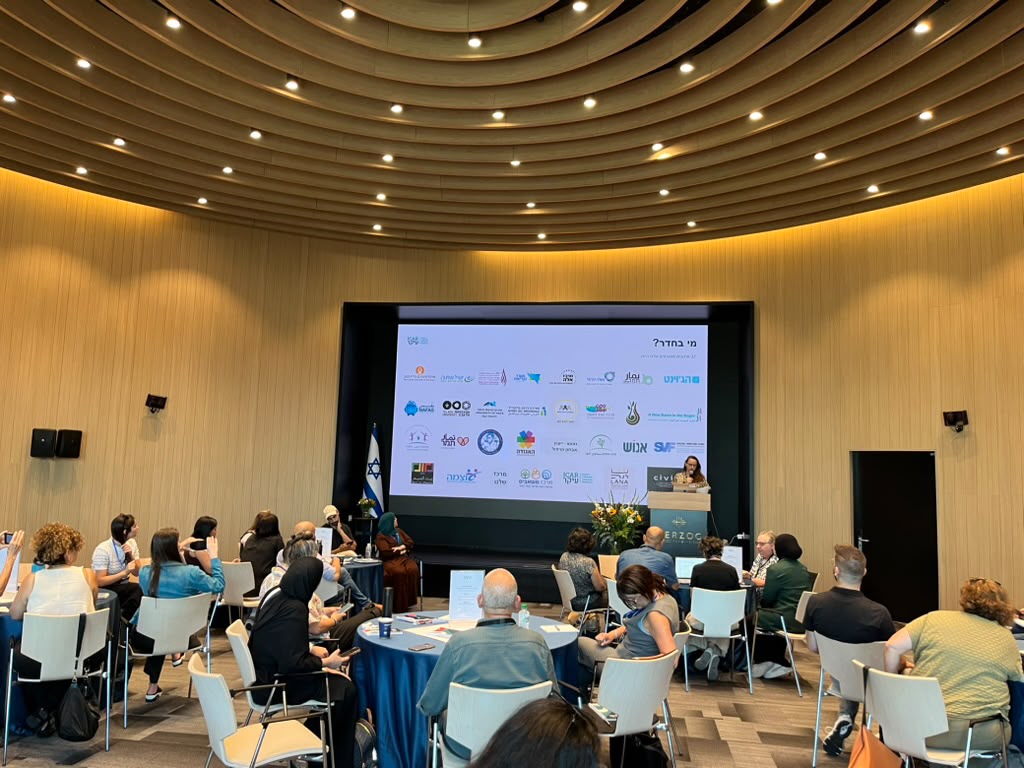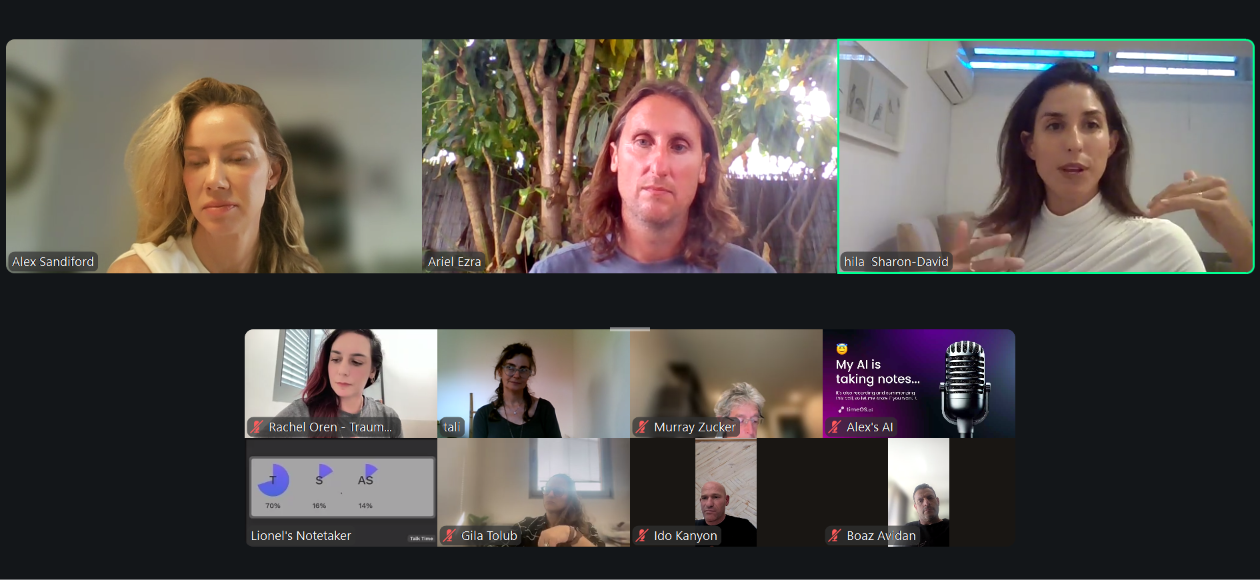
On September 12, 2025, a few days before the Jewish New Year, ICAR Collective hosted a webinar on post-traumatic growth (PTG) with two people I deeply respect: Dr. Edith Shiro—clinical psychologist, author of The Unexpected Gift of Trauma—and Prof. Eyal Fruchter—psychiatrist, PTSD expert, and my colleague and friend since he is also ICAR’s Head of Medical & Scientific Affairs.
It was an hour of straight talk with no sugarcoating and real tools. From the first minute, the tone was human and direct. Cameras on or off—your choice—but fully present. Dr Murray Zucker joined from San Francisco and joked: “It’s early, but worth it.” That’s the spirit we love: practical, relational, and honest.
What We Mean by “Trauma” (and Why That Matters)
Edith began by widening the frame. Trauma, she insisted, is not just an event that happens to someone; it’s also the social field around that person. “Trauma is relational,” she said. “It’s not just that there is a war, or that somebody died. It’s how people are reacting to your pain. And the healing of trauma is relational as well.”
She asked to drop the policing of what “counts” as traumatic. “Trauma is subjective. Who decides what is traumatic and not traumatic? ” When a child is bullied and a parent shrugs it off as “kids’ problems,” that dismissal becomes part of the wound. The inverse is also true: validation can be medicine.
She then named something many of us live without always naming: “Trauma is contagious… horizontally in families and communities, and vertically across generations.” As the granddaughter of Auschwitz survivors and of Syrian refugees who walked from Aleppo to Israel, she described how inherited experience can shape reactions in the present—stocking water during sirens even when food and water are abundant—“this is coming from someplace else… from my inheritance.” Her point was not fatalistic. She brought in the language of epigenetics as a possibility: patterns can be changed, expressions can transform.
PTG: A Spiral, Not a Checklist
From there, we moved to PTG. “Everybody knows about PTSD… my invitation is to see that there’s something else besides PTSD, and it’s PTG.”
Edith doesn’t treat PTG as a slogan. She uses a five-stage spiral: (1) radical acceptance; (2) safety and protection; (3) new narratives; (4) integration; and (5) wisdom and growth. You cannot bypass acceptance and pain.

The audience didn’t sit quietly. Murray asked what we hear from many leaders: “Do you have
any suggestions about specific strategies, interventions for the society, for the culture, so that it will grow?”
Edith answered without jargon: “Open physical spaces for community conversation,” and start with “VAR: Validation, Acknowledgement, and Recognition.” Not political panels; spaces where people can say plainly what this period is doing to them. She recalled the Surfside collapse in Miami, where people gathered twice a day for a month: “They formed a new identity there… a new story to tell.” The principle travels: identities that honor pain and dignity at the same time are more stable than identities built on labels alone.
Clinically, Eyal offered another simple operating system: “A is Awareness… B is Balance… C is Connectiveness. We should be aware of what we’re going through, keep balance—not to get panicked, not to be judgmental—and connect to people and purpose.”
On the brain level, Eyal also translated PTG for the audience: “In PTSD, the amygdala is overworking and the prefrontal cortex is working far less. In post-traumatic growth, we are not curing the amygdala, but we are advancing the prefrontal area.” Edith built on that with research she follows: “There are MRI studies at Columbia by Dr. Lisa Miller showing a thicker layer in parts of the prefrontal cortex among people who have developed more spiritual connectivity—a protective factor against future trauma.” Whether your route to “connectivity” is praying, nature, music, or volunteering, the direction is toward something larger than the isolated self.
The Israeli Snapshot—Are We Seeing PTG Yet?
“Positive consequences don’t mean we put on rose-colored glasses,” she cautioned. “This is not a bypass.” Timing matters, and she didn’t pretend otherwise. “Right now in Israel, please do, please continue to use defense mechanisms such as dissociation or avoidance, because right now, it’s not the time to be doing radical acceptance. Survive first; process later. For many people, that’s the honest order.”
I asked Eyal to ground all this in our current Israeli reality. He didn’t flinch. “Although we are in the middle of fighting… and we’re not even close to starting to process what we’ve been through,” he said, “we still can see a lot of places where post-traumatic growth is starting to emerge.”
He sees it in the ecosystem’s reaction—“the country is bubbling with ideas how to cope with it”—and in our deliberate choice of narrative at home. “We’re not putting the army and the military personnel in the political war… we give them full credit for what they’re doing.” On the personal level, he pointed to people changing priorities—to Yuval Raphael, the Nova survivor who decided in a garbage can that life would not be postponed anymore and made her dream come true when she participated in the Eurovision.
Can PTG Be Systemic
We pushed the question further. What should the Israeli health system, the education system, and government do differently if we take PTG seriously?
Edith’s first move was conceptual: “Put PTG on the map as a possibility. Don’t just treat symptoms; promote growth.” Second, stop thinking only in one-to-one mode: retreats are valuable, but they’re not enough. “Open spaces for the society to speak, to validate, to build narrative.” That includes teachers and principals who are holding five- and seven-year-olds telling hard stories—“what’s the narrative we give them?”
I added that outcomes need to reflect what we’re actually trying to achieve. In the U.S., the Cohen Veterans Network added function measures—work, parenting, relationships—because patients were thriving even when DSM symptom scores lagged. The point isn’t to pretend symptoms don’t matter; it’s to measure the change people feel in their lives.
Identity work came up again when we touched on soldiers and language. Edith explained the nuance: moral dilemmas, identity shifts, and collective holding are intertwined; naming them precisely helps. Her language on “new narratives” is practical: move from “what happened to me” toward “who I’m becoming,” and do that work in community, not alone.
The Controversial Line of the Day
Late in the hour, Edith dropped the hardest line of the day: “Not always resilience is the best thing to get to growth. If we’re so much into resilience—so strong with solutions for everything—we don’t get to the place where we’re a little bit broken, a little bit shaken, open enough to new perspectives.”
Murray Zucker connected it to Jacob wrestling the angel: “I’m not going to stop wrestling until I get a blessing”. Edith smiled: “That’s the exact verse I use to describe post-traumatic growth.” It’s an Israeli truth, whether we like it or not: sometimes we have to sit in not-knowing long enough for something new to emerge.
We closed by circling back to basics: Post-traumatic growth is not about ignoring the suffering. It’s about radical acceptance at the right time; safety and honest community; new narratives that don’t trap us in a single identity; integration of shadow and strength; and finally, turning pain into purpose.
Edith gave us language. Eyal mapped the nervous system to daily life: awareness, balance, connectedness. The chat filled with people recognizing themselves somewhere on that spiral—stage one in one domain and stage five in another. That’s not failure. That’s the work.
If this is the conversation you want to be part of—serious, pragmatic, and hopeful—join us next time. We can build the narrative together. And we’ll keep doing the simple, difficult things that make growth possible—relationship by relationship, system by system, here, now.
🎥 Recording available: The session was held in English. https://replay.peech.ai/v/b9dTWshGGvMN