What if one of the most important resources for healing is something we carry with us all the time?
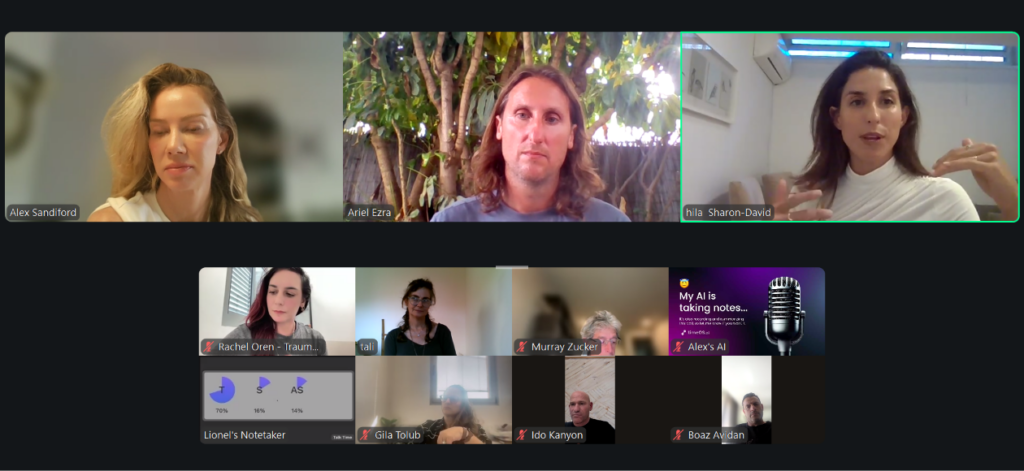
That question was at the heart of ICAR Collective’s recent webinar, “Resilience in Motion: Movement-Based Pathways to Regulation, Connection and Care,” which brought together practitioners working in sports psychology, trauma-sensitive yoga, therapeutic surfing and dance.
On the surface, these approaches look very different. One takes place on a yoga mat. Another in the sea. Another in a dance studio. But throughout the conversation, the speakers kept returning to the same idea: when trauma affects our sense of safety, connection and control, recovery may need to involve more than what we think and say. It may also depend on how we experience our bodies.
As facilitator Alex Sandiford explained at the outset, the aim was not to rank approaches or define a new field. Rather, she noted that “something is happening… across very different practices, whether it’s in the ocean or on a mat or even in a dance studio.”
When words are not enough
Dr. Hila Sharon-David, a sports and exercise psychologist, opened with a simple but challenging idea:
“The body is an active agent of change. But we mostly turn to words when we talk about mental health care.”
Most of us are used to thinking of therapy as conversation: two people sitting together, trying to put difficult experiences into words.
Words matter. But sometimes the body is communicating something first.
Dr. Sharon-David spoke openly about experiencing panic attacks during her military service and about the role movement played in her own recovery. Running, walking and breathing began as ways of coping. Over time, that experience helped shape years of research into physical activity, stress and well-being.
Her point was not simply that exercise can help people feel better. It was that the body itself can offer useful information.
Where do you feel this emotion? What sensation is present? What does your body seem to need right now?
She ended with a question that stayed with the panel throughout the webinar:
“What would mental health care look like if movement became a routine part of assessment, treatment and recovery, not an optional add-on?”
Practicing the experience of coming back
Dr. Ariel Ezra brought the conversation into the water.
At HaGal Sheli, where trauma-focused surf groups expanded following the Iron Swords War, resilience is not only something participants talk about. It is something they physically experience.
“You literally bounce back all the time,” Ezra said. “You fall down and then you bounce back.”
Participants fall, recover, try again and do it alongside other people. The group itself becomes part of the experience.
Ezra recalled one participant saying that for more than an hour in the water, there had been no flashbacks.
“I was only here,” Ezra recalled. “Only in the water, only with my friends, only with the instructors.”
For someone living with traumatic memories, being fully present is not necessarily a small achievement. The sea, the focus required to surf and the presence of others can all help anchor attention in the immediate moment.
Healing also means restoring choice
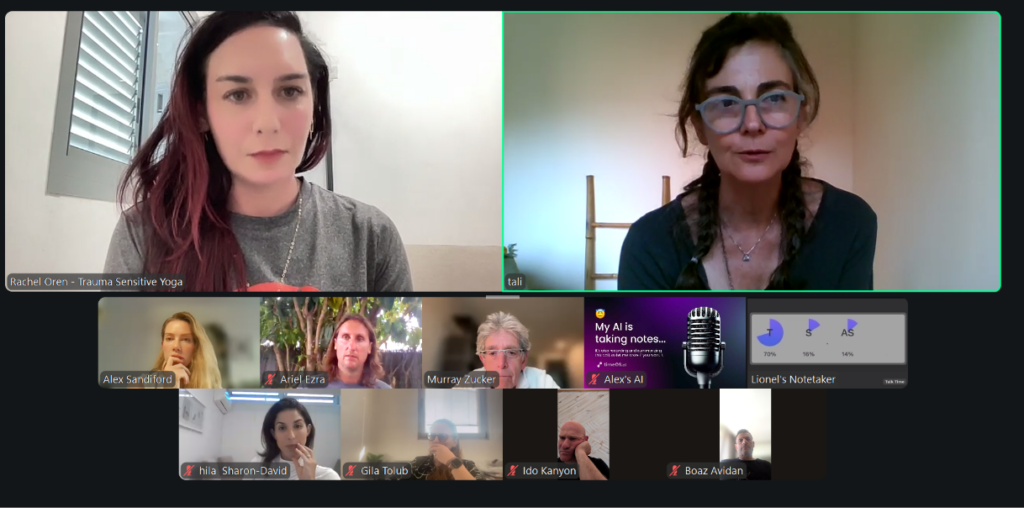
Rachel Oren, Israel’s first certified facilitator of Trauma Center Trauma-Sensitive Yoga (TCTSY), introduced an important note of caution.
Movement is not automatically therapeutic simply because the body is involved.
For people who have experienced complex trauma, physical sensations themselves can feel overwhelming. That means the way movement is introduced matters.
“Trauma is an absence of choice,” Oren explained.
Her work places choice at the center. Participants decide whether and how to engage. The facilitator invites rather than directs. Boundaries, transparency and awareness of power dynamics are part of what makes the work safe.
Oren also returned to the importance of relationships. Whether the setting is “a yoga mat… a wave… or a dance studio,” she said, what matters is that someone is there with the person.
That echoed what others were describing in very different settings. The method may change, but trust, connection and a sense of safety remain central.
What happens when people move together
Tali Wertheim, representing Vertigo Dance Company’s movement work, shifted the focus toward the group.
She described what can happen when people begin moving together in a shared space. Bodies start to “resonate” with one another. Contact, weight, rhythm and movement become forms of communication that do not depend on words.
She spoke about soldiers who had recently returned from war entering the studio and, over repeated sessions, beginning to move with others in ways they had not expected. She’d noticed it rarely ended there: some went on to try surfing, others yoga, running, or other forms of sport and movement.
Her description of the process was one of the most memorable lines of the webinar: movement can bring “life into body, or body into life again.”
Some changes are felt before they can be fully explained.
Where the field goes from here
The speakers came from very different professional backgrounds, but they were often pointing in the same direction.
No one suggested that movement should replace psychotherapy or other established forms of mental health care. What they shared was the belief that the body deserves a more intentional place in how we think about trauma and recovery.
They also agreed, in different ways, that this work has to be done carefully.
Movement-based approaches need to be trauma-informed. People need choice and agency. Facilitators need appropriate training and supervision. Community programs and clinical care need stronger connections. And promising approaches need to be studied so that practice can develop alongside evidence.
Dr. Sharon-David spoke about clinicians who understand the value of physical activity but do not always feel confident integrating it into their work. Ezra described efforts to connect surf therapy with academic training and research. Oren emphasized clear professional boundaries and collaboration with clinical teams.
Wertheim put the broader challenge simply when she said that “the world of separation is already passé.”
Psychology, neuroscience, movement practice, community care and lived experience often operate in separate professional worlds. But the people seeking support do not experience themselves in separate parts.
For Israel, where the need for trauma and resilience support remains profound, the next steps are practical: build stronger bridges between research and practice, create clearer standards for trauma-informed movement work, and give clinicians and community practitioners more opportunities to learn from one another.
Near the end of the webinar, Oren offered a simple observation:
“Our bodies are a resource for all kinds of untapped wisdom.”
The challenge now is to make better use of that resource — carefully, responsibly and together.
Watch the webinar https://youtu.be/JBiYasqIiqs?si=440MkcCEiLLJkOg9