Today’s webinar made one thing clear – trauma and addiction can no longer be treated as separate issues.

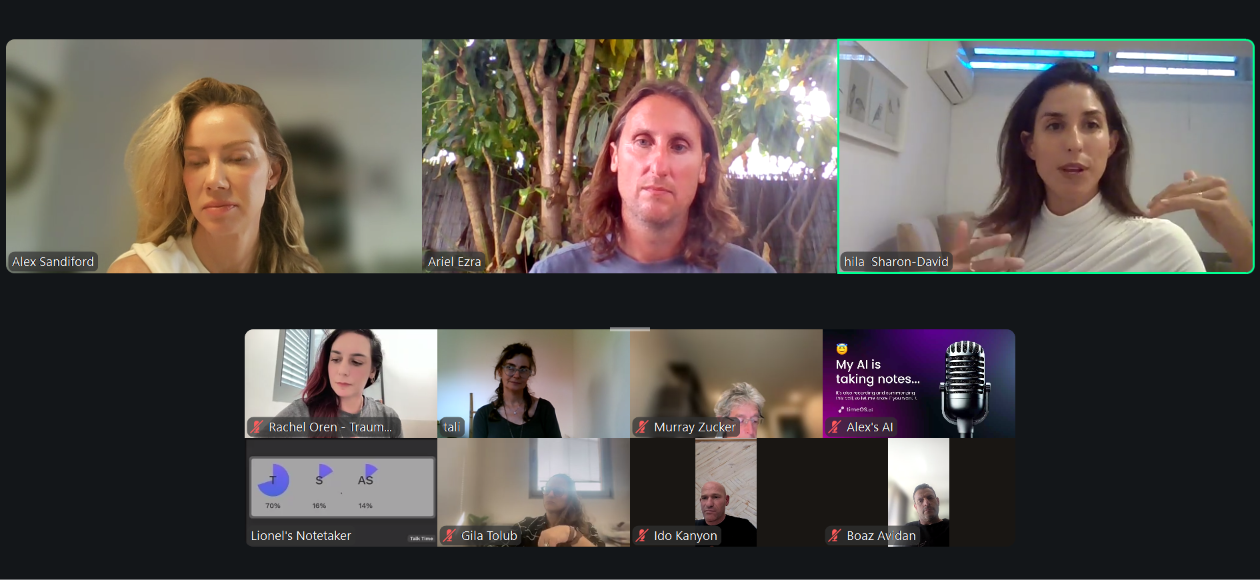
In a conversation hosted by ICAR Collective together with the Israeli Center on Addiction, Professor Eyal Fruchter and Professor Shauli Lev-Ran laid out a reality that is both painful and urgent.
Since October 7, mental distress has risen sharply across Israeli society, and with it, so have addictive behaviors. What emerged from the discussion was not only a warning, but also a call to think differently about care, prevention, and national responsibility.
Opening the webinar, Gila Tolub framed the issue: “We too often look at these as separate phenomena,” she said, referring to trauma and addiction, “but they’re very intertwined.”
Trauma does not only lead to visible symptoms such as anxiety, depression, or PTSD. It also drives people to self-medicate, often quietly, often functionally at first, and often without anyone around them recognizing the risk until the pattern has deepened.
According to ICA’s study, “one in four Israelis report increased use since the beginning of the war.” That includes alcohol, cannabis, and prescription medication. In other words, this is not a marginal issue affecting a small subgroup. It is woven into the way many people are coping with prolonged distress.
Professor Eyal Fruchter, Head of Medical and Scientific Affairs at ICAR Collective and Chair of the National PTSD Council at Israel’s Ministry of Health, described the current moment with blunt honesty: “We are not at the beginning of the crisis, we’re actually already inside it.”
He reminded participants that Israel has now been living with unprecedented exposure to trauma across multiple populations: survivors, soldiers, evacuees, children, families, and entire communities.
What follows trauma, he explained, often feels understandable in the short term. People cannot sleep. They feel anxious, hyperaroused, or physically in pain. So they reach for something that helps. “At the beginning, it’s working,” he said. “It’s helping a lot of people.”
But what starts as relief can become dependency, and what feels manageable at first can later undermine healing, functioning, and family life.
Fruchter also pointed to a major systemic gap. Israel has places that treat PTSD, and places that treat addiction, but too often they are still separate. “What we need is a greater combination and a greater understanding of how to combine the two,” he said. That is not a technical detail. It is a structural challenge that determines whether people receive care that actually matches what they are going through.
Professor Shauli Lev-Ran, one of the founders of the Israeli Center on Addiction, then widened the lens. He began with a sentence that captured both the frustration and the opportunity of this moment: “There are periods in life that things that were kept in the shadows for a long time can no longer be left there.” If PTSD once lived in the shadows in Israeli society, he suggested, problematic substance use has done so as well.
Lev-Ran was careful to expand the conversation beyond the narrow image many people still have when they hear the word addiction. “We’re not really talking about addiction here,” he said at one point. “We’re talking about that whole half of the spectrum that we call problematic use and addiction.”
That distinction matters. If we only pay attention when someone reaches the most severe end of the spectrum, we intervene far too late.
Again and again, he returned to the logic of self-medication. “Where there is human distress, people are gonna self-medicate,” he said. “That’s just part of biology.” Later, he put it even more plainly: “People use substances because they’re in pain.” Not because they are morally weak. Not because they are fundamentally different from everyone else. Because they are suffering, and because relief feels urgently necessary.
One of the strongest moments of the webinar came when Lev-Ran described October 7 and the war that followed not as a “small T” or even “big T” trauma, but as “huge T.” In a small country where nearly everyone is connected through family, service, geography, or media exposure, that scale of trauma does not remain limited to those directly attacked. It spreads through networks, homes, screens, schools, and workplaces. The result, he argued, is widespread emotional distress and, inevitably, widespread self-medication.
What makes this especially dangerous is that mental health symptoms may improve while substance use habits remain. Lev-Ran described ICA’s research showing that although distress may decline after an initial spike, “problematic substance use remains.” Once people adopt a coping habit, it can persist long after the original stressor has changed. That is why the issue cannot be postponed until “after the war.” If the habit stays, the consequences will stay too.
The webinar did not stop at diagnosis. It also outlined what a more serious response could look like: prevention in schools, training for frontline professionals, integrated care models, targeted interventions for high-risk populations, research, public awareness campaigns, and policy change. Lev-Ran’s most forceful policy recommendation was simple: any organization seeking public funds to treat trauma should also be required to address problematic substance use. “If you’re treating PTSD,” he said, “and you appreciate how high the rates of problematic substance use are, and you’re not addressing it, from my perspective, you’re not doing your job.”
That sentence captures the challenge ahead. This is not a side issue. It is not optional. It is central to whether trauma care in Israel will be effective.
The webinar also touched on the role of stigma. Too many people still think addiction is something that happens somewhere else, to someone else. But as Gila reflected near the end, awareness may be as important as eliminating stigma entirely. “As long as people know where to turn for help, professionals know what questions to ask, as long as awareness is really, really high,” she said, progress becomes possible.
She closed with a clear call to action: “When you hear trauma and addiction being treated separately, challenge that.” That is a message for providers, funders, policymakers, and community leaders alike.
The systems we build now will shape not only how we respond to suffering today, but also what kind of resilience Israel will have in the years ahead. The window to act is now.
The recording of the webinar will be uploaded to YouTube soon.